
Conserve our Oceans: Life below water in Indonesia
- What geographical and political characteristics shape Indonesia as an archipelagic state?
- What role does international maritime law play in the use and control of marine areas?
- What threats exist to maritime spaces and resources?
- How can states combat illegal activities at sea?
- What strategies exist for the sustainable use of the oceans and for marine conservation?
- What is the importance of international cooperation and financing in climate and ocean protection?
Additional Information: The Importance of the Blue Economy
The Indonesian ocean policy presented in the video is increasingly guided by the concept of the Blue Economy. This concept is defined in different ways by various international organizations. The United Nations has compiled several widely recognized definitions (click here for more information), all of which share the common goal of promoting the sustainable use of marine resources while simultaneously fostering economic growth, employment, and social well-being. At the same time, the long-term health of marine ecosystems should be preserved.
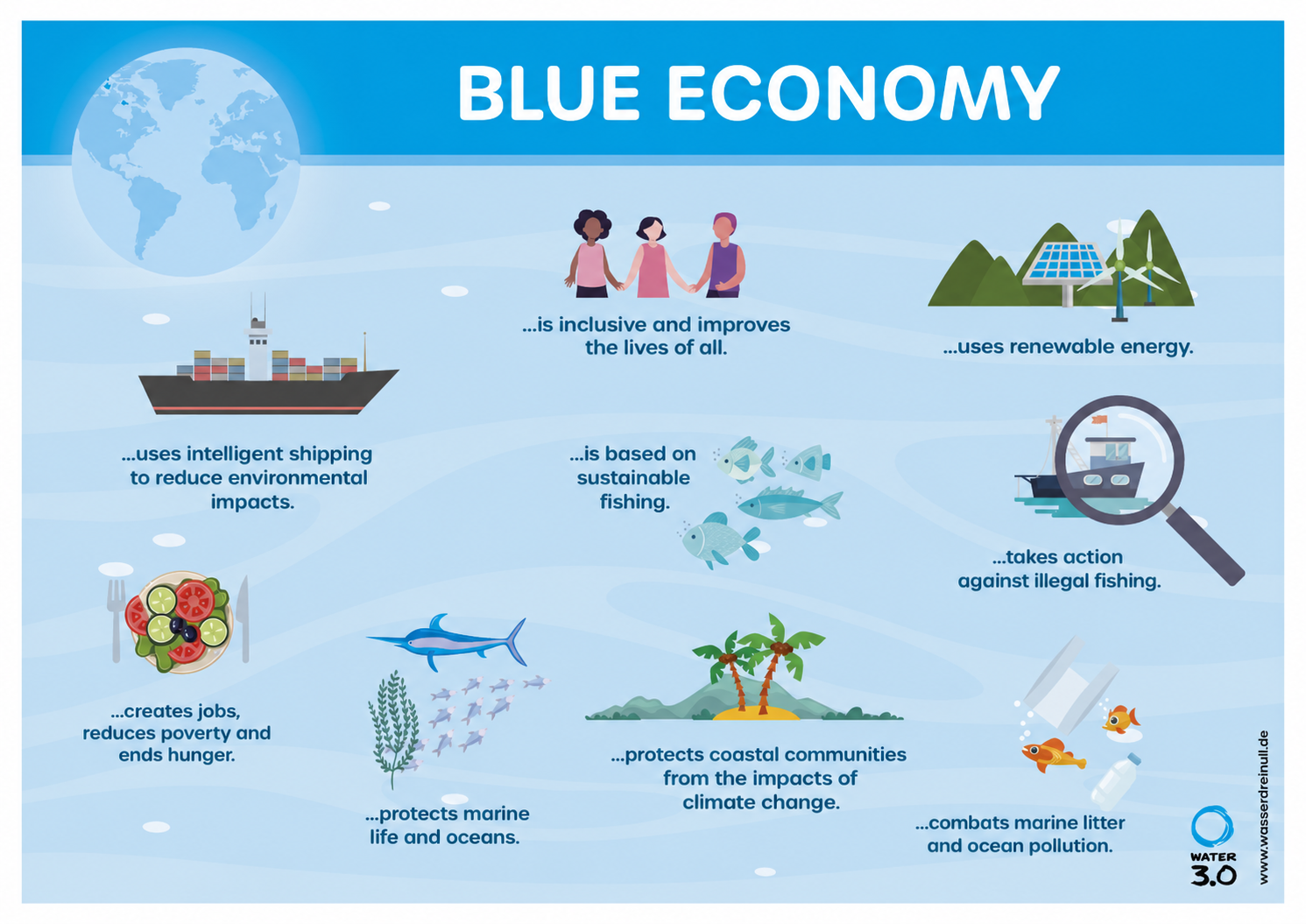
Image source: What is the “Blue Economy”?, Blue Economy - Wasser 3.0
The oceans play a central role in sustaining life on Earth: they produce around half of the world's oxygen, host a large share of global biodiversity, and provide food and livelihoods for billions of people. At the same time, they form the basis of numerous economic sectors, including fisheries, shipping, tourism, renewable energy, and scientific research.
However, marine ecosystems are increasingly under pressure due to overfishing, plastic pollution, oil spills, habitat loss, and the impacts of climate change. One particularly serious issue is ocean acidification caused by the absorption of carbon dioxide, which damages sensitive ecosystems such as coral reefs.
To preserve the economic and ecological functions of the oceans in the long term, many countries and international organizations are promoting a sustainable Blue Economy. This includes expanding marine protected areas, supporting sustainable fisheries, and investing in research and environmentally friendly technologies. These objectives are closely linked to the Sustainable Development Goal 14 (SDG 14), "Life Below Water," which aims to conserve and sustainably use the world's oceans and marine resources.
Overall, both the video and the concept of the Blue Economy demonstrate that economic development and marine conservation do not have to be conflicting goals. Instead, the two can be successfully combined when ecological, social, and economic interests are considered equally.
Source
Wasser 3.0 (o. J.). Blue Economy - der Ozean als riesiges Wirtschaftssystem. Blue Economy - Wasser 3.0