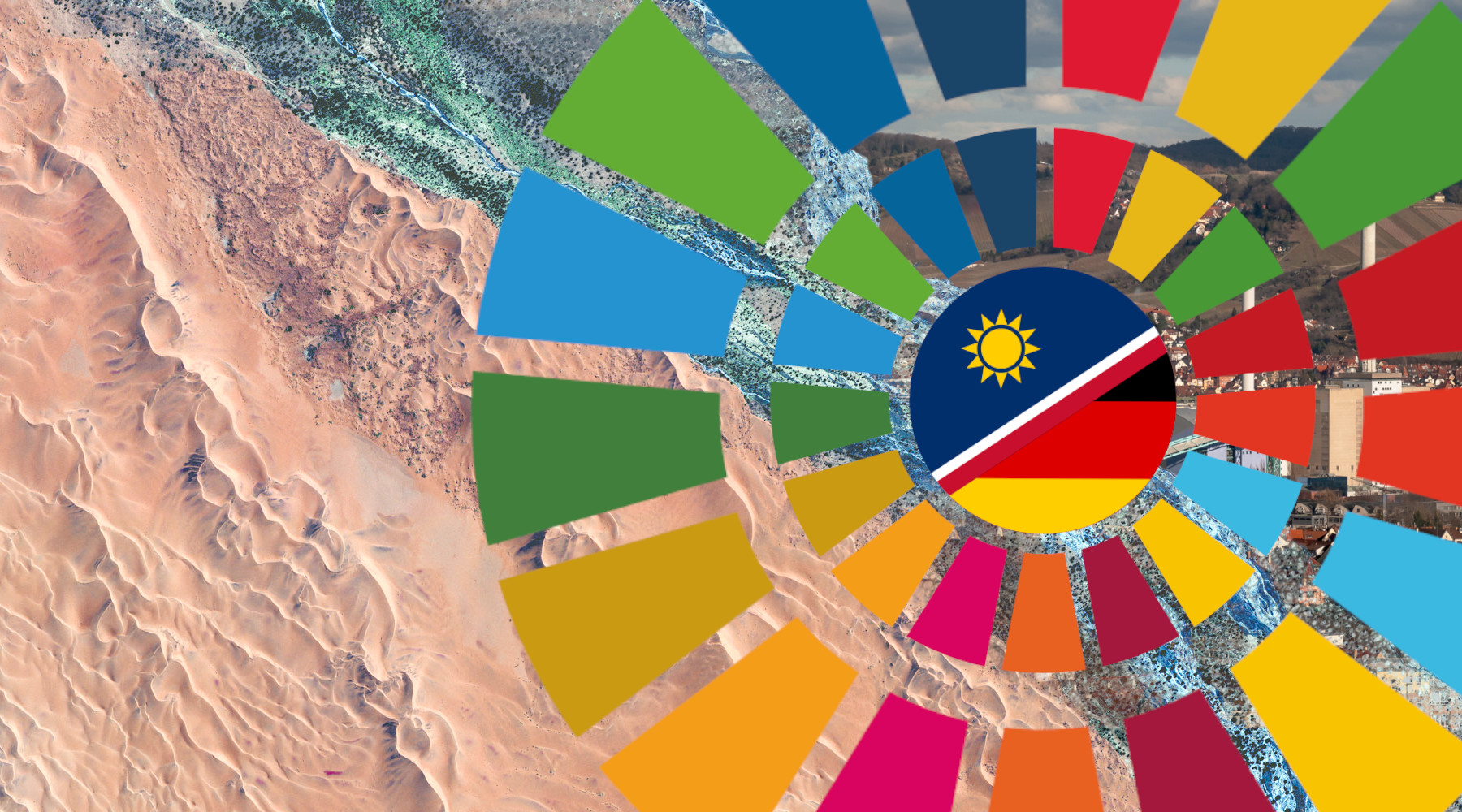
This seminar is open for students from all disciplines who are curious to explore the relationship between the Global South and North with focus on Namibia and Germany, and their Green Hydrogen endeavour.
Both countries, Namibia and Germany, are heavily invested in Green Hydrogen, on political, scientific, and economic level. The technology promises a huge contribution towards the achievement of the United Nations's 17 Sustainable Development Goals.
The seminar looks deeper into the implications of Green Hydrogen for Namibia and Germany and tries to expand the view beyond the technical possibilities and promises. Both countries are compared with regard to their achievements and challenges towards the SDGs; Green Hydrogen will be put in context of each countries' sustainable development strategy.
Furthermore, Namibian-German relations are explored, with focus on a genocidal past and the long and weary way to reconciliation, restitution, and the mediation of a shared history. How does this past even connect to something like tomorrow's Green Hydrogen? Also, Green Hydrogen will be put in context from a different angle by asking how indigenous knowledge and future technologies collide and how climate justice informs and frames the debate.
#sdg4,
#sdg7, #sdg17, #globalsouth, #namibia, #wickedproblems,
#germany, #gh2 #GreenHydrogen
You are able to recall and deliver basic facts on Namibia and German-Namibian relationship, especially with focus on sustainability challenges.
You are able to identify and describe measures and initiatives that deal with challenges of sustainable development on different levels of society.
You can reproduce the basic facts about Green Hydrogen as a future technology, and its role in the Namibian-German relations.
You can put the technology in a critical context with debates on Climate Justice and the role of indigenous people.
You are able to relate the mutual history of Namibia and Germany to present day's relatsionship of both countries. This includes the reproduction of the basic facts about the Herero and Nama genocide as well es the process of political recognition and efforts towards reconciliation in the 21st century.
You are able to work on possible ways to actively contribute to the ongoing debate on Green Hydrogen, together with fellow students.
The general goal and expected impact of this course are:
- Achievement of a deeper and nuanced understanding of Green Hydrogen and its role in Namibian-German relations.
- Raising of awareness for the complexitiy and dimensions of sustainability.
- Improvement of the understanding among nations and cultures.
The challenge divides into eight chapters. Every chapter consists of a three-hour workshop and mandatory activities in advance/in between.
Guest speakers will contribute to some of the topics. One session takes place at the Linden-Museum Stuttgart (guided tour).
Learning follows the principles of inverted classroom and self-directed learning. Workshop sessions are primarily reserved for interaction, feedback and counselling. Supportive literature, media and contacts will be provided.
Dr. Thorsten Braun (thorsten.braun@zlw.uni-stuttgart.de)
University of
Stuttgart
Centre for Higher Education and Lifelong Learning
Azenbergstraße 16
70174 Stuttgart, Germany
Phone:
+49(0)711 685 8028
Every student is required to engage actively throughout the course and prepare for each session. A self-chosen Challenge related to the seminar topic concludes the course. This Challenge should lead to a final product or activity that is mandatory for the final passing, e.g. an essay or a meaningful activity outside the classroom related to the seminar topic, like giving a presentation to another audience, shooting of a short film, engaging with actvists or researchers related to Namibia and Germany.